Quick answer: why morning light matters
Bright light in the first hour or two after waking tells your body clock that the day has started, which helps you feel alert in the morning and sleepy at a sensible time at night. Outdoor daylight is far brighter than indoor light, even on a cloudy day, so a short time outside does more than hours under office lights. A screen does not replace it. Use the morning for daylight and the evening for dim, warm light.
How morning light sets your body clock
Your master clock, the suprachiasmatic nucleus, keeps a rhythm that runs a little off 24 hours. Light reaching special melanopsin cells in the retina resets it every day. Light in the morning moves the clock earlier; light late in the evening pushes it later. That is why the same light that wakes you up at 8 am can keep you awake at 11 pm. CircadianShield's circadian rhythm guide covers the biology in more depth.
A steady morning signal also makes the evening signal matter less. People who get bright light early in the day tend to be less affected by moderate light at night than people who spend all day indoors under dim light.
How bright is morning light, compared with indoors and screens?
| Light source | Typical illuminance at the eye |
|---|---|
| Direct sun | Up to about 100,000 lux |
| Overcast daylight outdoors | Roughly 1,000 to 10,000 lux or more |
| Light therapy box at its rated distance | Often rated at 10,000 lux |
| Bright office lighting | About 300 to 500 lux |
| Typical living room in the evening | About 50 to 200 lux |
| Laptop or monitor at normal distance | Usually tens of lux, up to a few hundred close up and bright |
The gap is large. Even a grey morning outdoors is usually several times brighter than an office, which is why getting outside is the most useful single change most people can make.
How long should you get morning light?
There is no single proven dose, but common guidance looks like this:
- Sunny morning: around 5 to 10 minutes outside.
- Cloudy morning: around 10 to 20 minutes.
- Heavy overcast or winter: 20 to 30 minutes or more.
These ranges are widely shared by researchers in public talks, including Andrew Huberman's podcast, and line up with how much brighter outdoor light is than indoor light. Do not look directly at the sun. Walking outside, sitting near an open window, or having breakfast on a balcony all count. Glass windows cut some of the light, so outside beats inside by a window.
What about light boxes and winter mornings?
In winter, at high latitudes, or before sunrise, some people use a light box rated at 10,000 lux, usually for 20 to 30 minutes in the morning at the distance the maker specifies. Light boxes are also used for seasonal affective disorder. If that is why you are considering one, talk to a clinician first, especially if you have an eye condition, take photosensitising medication, or have bipolar disorder.
Does a bright screen count as morning light?
Not really. A screen is far dimmer at the eye than daylight, so it cannot do the job of going outside. What a screen can do is avoid working against you: a heavily warmed, dimmed screen first thing in the morning sends the wrong cue on top of a dim room. The better setup is cool, normal-brightness screens in the morning and during the day, then warm and dim after sunset. CircadianShield's guide to when to use a blue light filter lays out that schedule.
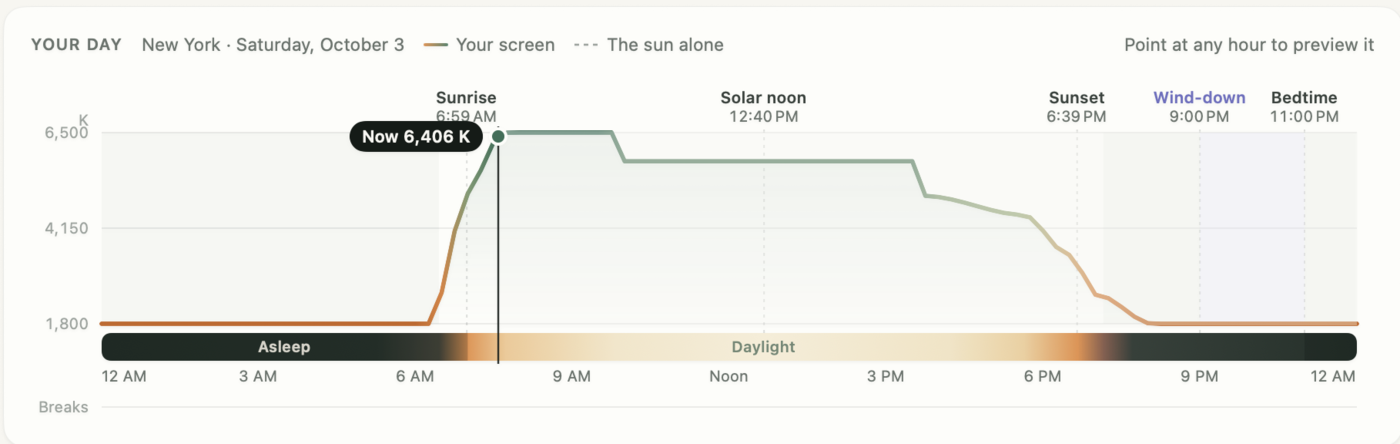
CircadianShield Pro does this automatically on Mac and Windows. Its Morning Boost, on by default when your wake time is within 90 minutes of civil dawn, ramps the screen toward 6500K daylight white from civil dawn and reaches it once the sun is 10 degrees up, and the solar schedule warms it again after sunset. Morning Boost does not replace going outside; it simply keeps your screen from staying in night mode while you start the day. Core includes manual warmth and software dimming, without the solar schedule or Morning Boost.
A simple morning light routine
- Get outside within an hour of wakingWalk, commute on foot, or have coffee outside. Longer on grey days.
- Open blinds and work near a windowDaylight indoors still beats overhead lights.
- Keep screens at normal daylight white in the morningSave warm, dim settings for the evening.
- Wake at a similar time each dayMorning light works best when the timing is consistent.
- Dim and warm everything after sunsetRoom lights and screens both.
Example: a winter weekday morning
- 7:00 am, wake up before sunrise: turn on bright room lights, and keep screens at 6500K.
- 7:45 am, after sunrise on an overcast day: walk outside for 20 to 30 minutes, at roughly 1,000 to 10,000 lux.
- 8:30 am, at your desk: sit near a window, where daylight is still far brighter than the 300 to 500 lux of office lights.
- Lunch: another 10 minutes outside if you can.
- After sunset: dim and warm the room and the screen.
A screen that follows your day
CircadianShield Pro brings back daylight white at dawn with Morning Boost and warms your display after sunset, on Mac and Windows.
Buy ProPro is $47 one-time, Core is $27 one-time, up to 2 computers, 30-day money-back guarantee.
Morning light: frequently asked questions
How long should I get morning sunlight?
Common guidance is about 5 to 10 minutes outside on a sunny morning, 10 to 20 minutes when it is cloudy, and 20 to 30 minutes or more under heavy overcast. Never look directly at the sun.
Does morning light through a window count?
It helps, but window glass cuts some of the light and you get less of the sky indoors. Going outside, even briefly, gives your eyes far more light than sitting by a window.
Can a bright screen replace morning sunlight?
No. A laptop or monitor delivers far less light at the eye than daylight. Keep screens at normal daylight white in the morning so they do not work against you, and get outside for the actual light signal.
Is a 10,000 lux light box worth it?
Some people use one on dark winter mornings, usually for 20 to 30 minutes at the distance the maker specifies. If you are considering one for low mood or seasonal affective disorder, talk to a clinician first.
What does Morning Boost in CircadianShield do?
Morning Boost is a Pro feature. When your wake time is within 90 minutes of civil dawn, it ramps your screen toward 6500K daylight white from civil dawn and reaches it once the sun is 10 degrees up, so your screen is not stuck in night mode while you start the day. It does not replace going outside.