Quick answer: what time should you use a blue light filter?
Start warming the screen around sunset, and make it strongest in the two to three hours before bed. That is when screen light has the most effect on melatonin and sleep timing. During the day a filter is optional: it does not protect your eyes from damage, and bright, cooler light in the morning and early afternoon helps keep your body clock on time. Leaving a filter on all day is not harmful, but it distorts colours and gives up the daytime light signal.
Why timing matters more than strength
Your body clock reads light through melanopsin cells in the retina, which respond most strongly to blue light around 480 nanometres. In the morning and through the day, that signal says "daytime" and keeps you alert. In the evening, the same signal delays the release of melatonin and pushes your sleep later. The effect of light depends on when you see it, not only on how much. Our explainer on blue light and sleep covers the studies behind this, including the 2014 Chang et al. e-reader study.
Harvard Health's long-standing advice is to avoid bright screens for two to three hours before bed. A filter is the practical version of that for anyone who cannot avoid screens: it keeps the screen usable while cutting the part of the light that matters most at night.
A blue light filter schedule that follows your day
| Time | Filter | Why |
|---|---|---|
| First hour after waking | Off, or a cool daylight setting | Morning light is the strongest cue to anchor your body clock. |
| Daytime work | Off or mild | No sleep benefit from filtering; colours stay accurate. |
| Sunset to two or three hours before bed | Gradually warmer | Matches falling daylight and starts lowering the evening signal. |
| Last one to two hours before bed | Strongest warmth, lower brightness | When melatonin starts rising and screen light delays it most. |
| Middle of the night | Deepest warmth and dimming | Keeps a quick check of a screen from waking you up fully. |
Is it okay to have a blue light filter on all the time?
Yes, it is safe. A screen filter does not harm your eyes, and there is no evidence that leaving one on all day damages anything. There are two costs to weigh:
- Colour accuracy. A warm screen shifts every colour. If you edit photos, design, or pick colours for work, keep the filter off or use a per-app exception during that work.
- Daytime light signal. Daylight-like light during the day supports alertness and a steady sleep schedule. Filtering it all day removes part of a signal your body clock uses. Getting outside matters more than your screen here, but there is no reason to filter screen light at noon for sleep reasons.
Should you use a blue light filter during the day for eye strain?
A filter during the day may feel more comfortable to some people, but it is not an eye strain treatment. The American Academy of Ophthalmology says the blue light from screens does not damage the eyes and does not recommend blue light glasses for eye strain. Eye strain comes mostly from long focus at one distance, blinking less, and a screen that is too bright or too dim for the room. If your eyes are tired by mid-afternoon, look at brightness, contrast, and breaks first. CircadianShield's guide to the best monitor settings for eyes and the 20-20-20 rule cover those.
Sunset schedule or fixed times?
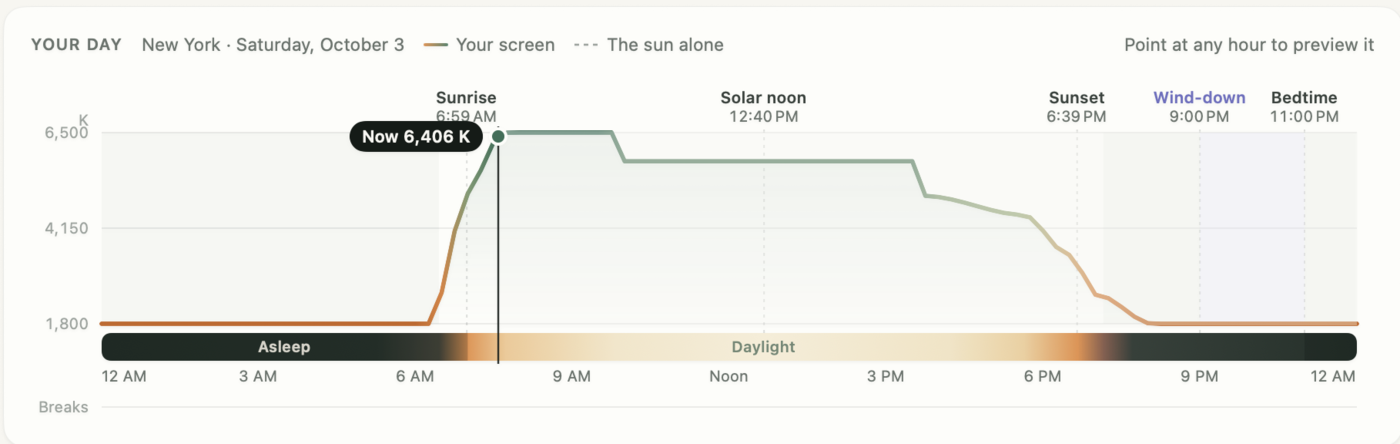
Both Night Shift on Mac and Night light on Windows offer a sunset-to-sunrise schedule or custom times. Either beats no schedule. A sunset schedule follows the seasons, so in winter it starts much earlier than in summer. A fixed schedule set from your bedtime keeps the evening ramp the same length all year. The most useful setup combines both: warm with the sun, then go deeper as your own bedtime approaches.
That combination is what CircadianShield Pro does on Mac and Windows. It calculates the sun's position at your location, tracks 11 twilight phases with smooth transitions from 6500K daylight to 1800K deep amber, and adds a wake and sleep schedule so the strongest warmth lines up with your actual bedtime. Morning Boost, on by default when your wake time is within 90 minutes of civil dawn, ramps the screen toward 6500K from civil dawn and reaches full daylight white once the sun is 10 degrees up, so the filter is out of the way when daytime light helps most. CircadianShield's guide to morning light and your circadian rhythm explains why that daytime light matters. Core gives you manual warmth and software dimming without the solar schedule.
When a blue light filter is not the answer
- Room lighting is brighter than the screen. Bright overhead LEDs in the evening send a stronger signal than a laptop. Dim and warm the room too.
- Your screen flickers. If your eyes hurt more when you turn the screen down, the cause may be PWM flicker, not blue light. See our PWM flicker guide.
- Your sleep problem started elsewhere. A filter helps with evening light. It does not fix stress, caffeine, an irregular schedule or a sleep disorder.
Example: a weekday screen schedule with sunset at 7:30 pm
- 7:00 am, waking: screen at 6500K daylight white, normal brightness.
- 7:00 am to 6:30 pm: stay at 6500K, or a gentle 5500K if you prefer a softer white during the day.
- 7:30 pm, sunset: start warming gradually toward 3400K.
- 9:30 pm, wind-down: 2700K and lower brightness, with room lights dimmed too.
- 10:30 pm, bedtime for a 7 am wake: 1800K deep amber if you are still on a screen.
Let the sun set the schedule
CircadianShield Pro warms your screen with the sun, deepens it before your bedtime, and brings daylight back with Morning Boost, on Mac and Windows.
Buy ProPro is $47 one-time, Core is $27 one-time, up to 2 computers, 30-day money-back guarantee.
When to use a blue light filter: frequently asked questions
What time should a blue light filter be turned on?
Turn it on around sunset and make it strongest in the two to three hours before bed. A sunset schedule follows the seasons automatically, and a bedtime-based schedule keeps the deepest warmth lined up with when you actually sleep.
Is it okay to have a blue light filter on all the time?
Yes, it is safe and does not harm your eyes. The trade-offs are less accurate colours and losing some of the daytime light signal that keeps your body clock on time, so most people are better off using it only in the evening.
Should I use a blue light filter during the day?
It is optional. There is no sleep benefit to filtering screen light in the morning or early afternoon, and the American Academy of Ophthalmology says screen blue light does not damage the eyes. Use it in the day only if it simply feels more comfortable and colour accuracy does not matter for your work.
How long before bed should I use a blue light filter?
Two to three hours before bed is the common guidance, in line with Harvard Health's advice to avoid bright screens for that long before sleep. Lowering brightness at the same time helps more than warmth alone.
Does a blue light filter work if I turn it on right before bed?
It helps less. Evening light affects melatonin over the hours before sleep, so switching on a filter five minutes before bed misses most of the window. Schedule it from sunset or a few hours before bedtime instead.